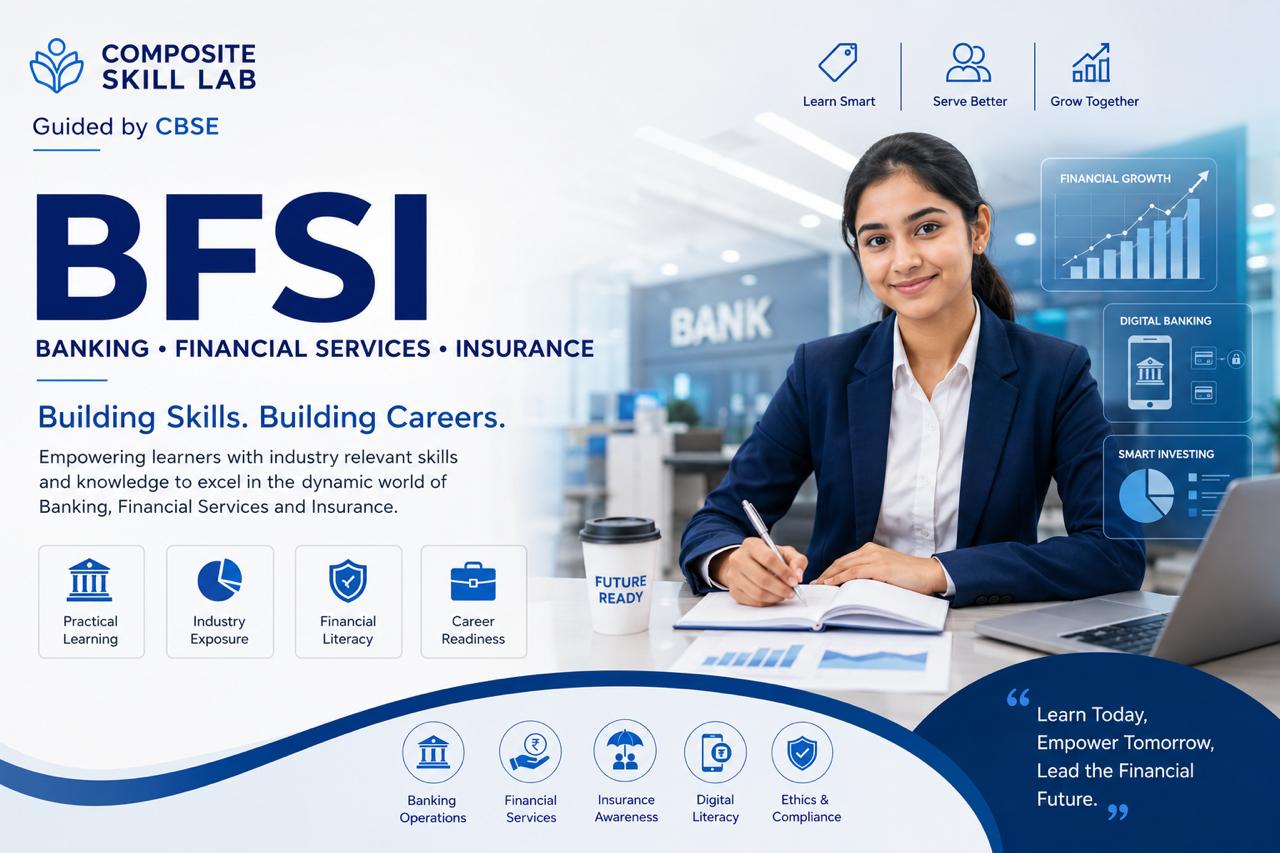
This sector helps students to build essential money skills for both everyday life and commercial settings. It breaks down how banking systems work, how risk is managed and how capital is put to work and giving learners a realistic handle on money management.
What Students Learn?
• Students get hands-on exposure to:
• Everyday Banking & Digital Payments
• Savings & Investment Options
• Financial Planning & Budgeting
• Insurance Types & Risk Protection
• Loans, Interest & Credit Management
• Basic Resource Management for Businesses
Learning Through Practice
Students learn by analysing real-world financial choices filling out transaction forms running interest calculations and working through budget scenarios. Hands-on exercises help them to develop sharp attention to detail, strong analytical habits and practical decision-making skills under varying economic constraints.
It also connects classroom Mathematics such as percentages, compound interest, data interpretation and ratios directly with personal and business finance.
Building Lifelong Financial Literacy
Students learn how to make smart financial moves, weigh risk against return and protect assets through insurance. This shifts money management from abstract Math formulas into practical day-to-day choices that support long-term economic stability.
Preparing for a Digital Economy
Understanding financial systems gives students a solid foundation for managing business capital or starting a new enterprise. As financial services move online, the skills built here open doors to roles in banking operations, accounting assistance, insurance sales, financial advisory work and business management.