
Safety
1. Guidelines
Creating a safe and conducive learning environment in a Composite Skills Lab is essential for the well-being of students, teachers, and staff. As these labs encompass a diverse range of tools and equipment for Fashion, Healthcare, Gardening/Agriculture, and Various hands-on activities, it is vital to establish comprehensive safety guidelines. These guidelines are designed to ensure that all individuals—principals, teachers, students, lab assistants, and housekeeping staff—are equipped with the knowledge and practices necessary to minimize risks, promote responsible behaviour, and effectively respond to emergencies. By fostering a culture of safety, we not only enhance the learning experience but also instil a sense of responsibility and awareness among all participants in the skills lab.
1.1 Safety Guidelines:
. Two wide doors for unobstructed exit from the CSL.
. An adequate number of fire extinguishers near CSL.
. Periodical checking of vulnerable points in the CSL avoid possibility of any mishap.
. It should be ensured that gas fittings in the CSL fulfil the desired norms and standards.
. Periodical checking of electrical fittings/ insulations for replacement and repairs.
. Timely and repeated instructions to students for carefully handling tools and equipment in the laboratory.
. Display of do’s and don’ts in the laboratory at prominent places.
. Safe and secure storage of all tools and equipment.
. Proper labelling and upkeep of tools and equipment.
. Proper safety and protection while doing practical work.
. Careful supervision of students while doing practical work.
. Advance precautionary arrangements to meet any emergencies.
. Conduct any additional experimental work only under supervision and with due advance permission.
. Availability of First Aid and basic medical facilities in the school.
. Conduct emergency response, evacuation and fire drills to ensure everyone knows what to do in case of emergency.
2. Roles & Responsibilities:
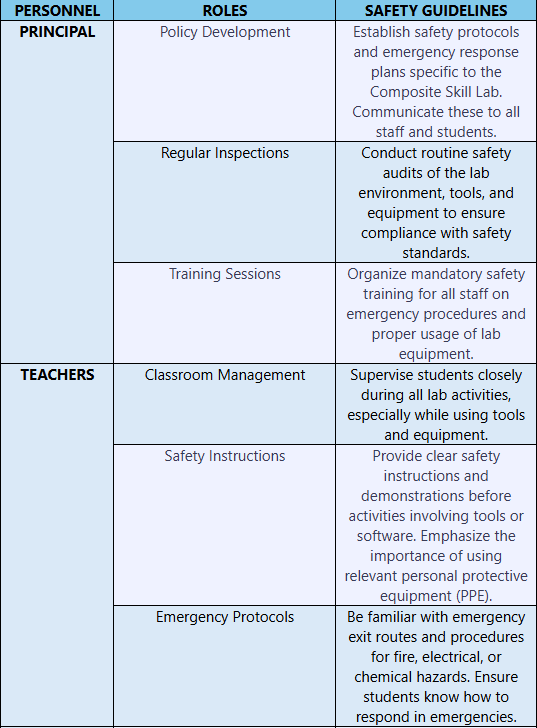
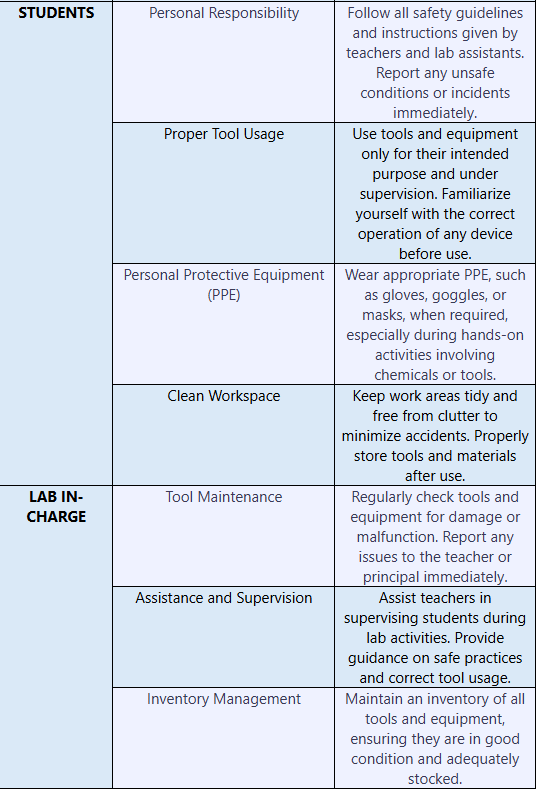
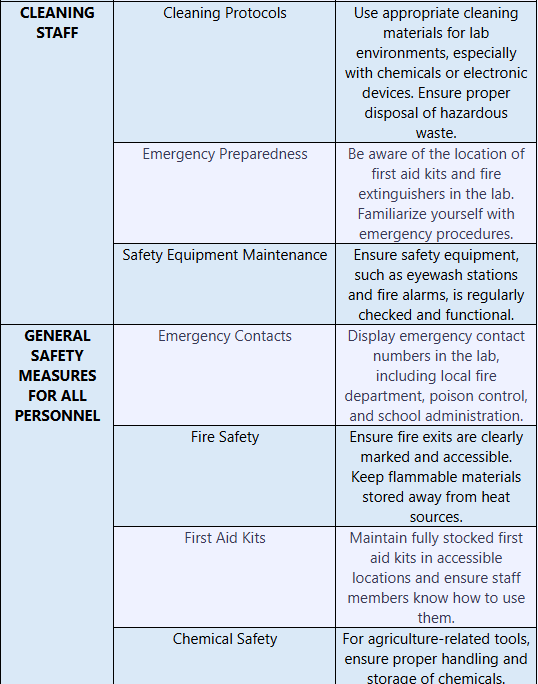
3. Safety Tools
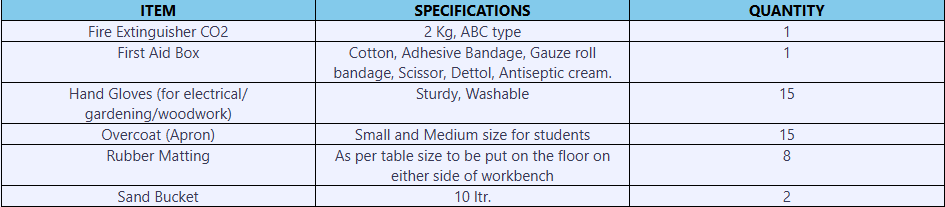
*Quantity (for a class of 40 students)
4. Safety Corner
. Placement: Positioning a safety rack near the entrance of the lab will ensure that students can quickly access the gear in emergencies, such as a fire outbreak or electrical shock.
. Contents: The safety corner should have adequate and relevant safety gear. The details of the general safety provisions can be found in Chapter 4. More safety equipment can be added as per the chosen skill subjects.
. Conduct regular safety drills to familiarize students with emergency procedures.
5. Posters/visuals
• Display posters with clear safety instructions and protocols.
• Position posters in prominent locations around the lab.
• Use bright colours and simple visuals to ensure readability and engagement.
6. Safety Drills
• Conduct regular safety drills to familiarize students with emergency procedures.
• Besides, safety drills mist be conducted regularly to ensure that the students are familiar with emergency procedures.
7. Safety Provisions embedded at the time of installation
It is important that during the installation of the tools, important safety provisions are embedded. Some examples can be as follows. The respective teacher for the skill subject should oversee that critical safety measures are taken during the installation itself.
7.1. Flooring
. Anti-Slip Flooring: Use textured flooring around areas prone to water spillage to prevent slips and falls.
. Anti-Static Flooring: Use anti-static mats to protect sensitive electronics from electrostatic discharge.
7.2. Electrical Safety
. Cable Management: Install under-desk cable trays and raceways to prevent tripping over wires.
. Surge Protection: Equip workstations with surge protectors and uninterruptible power supplies (UPS) to safeguard devices.
. Equip sewing machines with surge protectors and ensure proper insulation of all electrical cords.
. All plugs and switches should be away from water sources.
7.3. Safety while working
. Tool-Specific Safety Labels: Clearly label tools and machines with usage instructions and hazard warnings.
. Heat-Proof Surfaces: Install heat-resistant surfaces for using irons, steamers, and other equipment.
. Equip all machines with easily accessible emergency stop buttons for immediate power cutoff in case of malfunctions.
. Isolation Panels: Use insulated panels and barriers around electrical and mechanical systems to protect against accidental contact.
7.4. Disposal Units
• Provide proper containers for disposal and segregation of bio-medical wastes especially.
• Provide containers for safe disposal of needles and sharp tools.
• Handwashing Stations: Include sink areas with antibacterial soap dispensers and touchless faucets.
7.5. Health
• Emergency Protocols: Display first-aid procedures and maintain a stocked first aid kit in the safety corner.
• Provide shaded work areas and ensure proper ventilation to reduce the risk of heat exhaustion.
7.6. Storage
• Chemical Storage Cabinets: Use lockable, ventilated storage units for fertilizers, pesticides, and other chemicals to prevent accidental exposure.
• Keep/store sharp tools like pruners, shears, and shovels on pegboards with safety locks.
